The Daily Standard
Story Archive

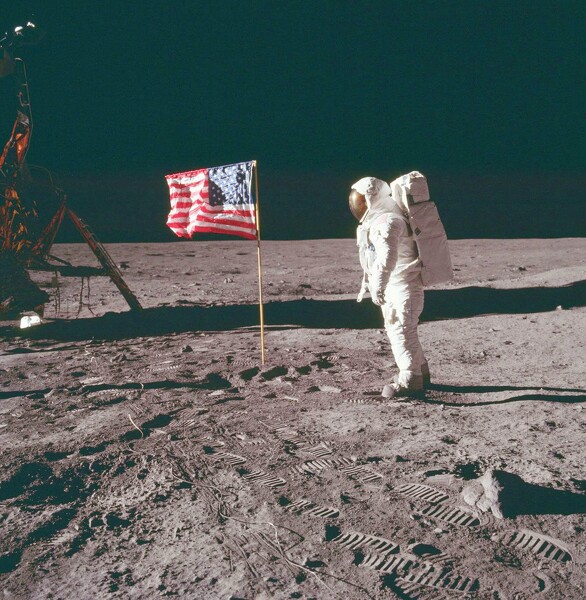
Wapakoneta native Neil Armstrong, the first man on the moon, took this photo of fellow astronaut Buzz Aldrin next to the U.S. flag at Tranquility Base in 1969.
NASA
ST. MARYS - More than 55 years ago, Wapakoneta native Neil Armstrong became the first person to walk on the moon, delivering the iconic line, "That's one small step for man, one giant leap for mankind." Despite the mountain of evidence proving the marvel of the lunar landing, speculation that the landing was faked started soon after and continues to grow.
Greg Brown, museum historian of the Armstrong Air & Space Museum, addressed a small crowd in St. Marys Monday with a presentation about the landing, evidence for its authenticity, and why some people vehemently maintain it didn't happen.
"NASA, universities around the world, professional scientists, engineers, pilots, news organizations (and) history books, all of those maintain that the United States landed 12 Americans on the moon between July 1969 and December 1972," Brown said Monday evening at the St. Marys Community Public Library.
Despite this, many people object to the official story.
"They have accused and continue to accuse the federal government of faking the lunar landings and of misleading the American people and everyone else, lying to everyone all these years," Brown said. "They have offered many examples of what they claim are evidences of the hoax."
Brown, who explained NASA's proof of the mission while also playing devil's advocate and then debunking the false claims, asked why the federal government would go through such hoops - spending millions of dollars and dedicating countless resources - to fake the landings.
He said hoaxers might say that national prestige was at stake.
"Our country's government was fearful that if the Soviets beat us to the moon and landed there first, then our reputation among the rest of the nations would suffer greatly," he said, echoing a common explanation of the myth. "They were so concerned that they decided to take the risk to fake the lunar landing so we could accomplish President (John F.) Kennedy's goal of 1961 and 1962."
Brown said the other explanation he's heard is that the landing was crafted to distract the world from the "quagmire of Vietnam," a claim he quickly debunked.
U.S. troops arrived in Vietnam at the end of 1964. Kennedy challenged the country to go to the moon in May of 1961.
"In that challenge, he said we want to go to the moon and bring the human back safely," Brown said. "Long before we were even fighting in Vietnam, NASA and the government were determined to go (to the moon)."
Brown presented four theories hoaxers may cite as their smoking gun, including that rockets don't work in a vacuum of space, that there was insufficient technology at the time for the landing to have happened, that outer space is too dangerous for humans, and the race-to-space timeline. They question why the U.S. was first to reach the moon when they were so behind the Soviets.
Brown debunked the first claim with Newton's third law: for every action, there is an equal and opposite reaction.
"If the rocket is sitting on the ground and the engines are firing, the exhaust is going downward, not pushing against the earth, it's just going downward," he said. "And because of Newton's third law, the rocket must go upward, so the fact that we don't have anything pushing against is irrelevant. We're not pushing - we're exchanging momentum with the exhaust gases. That's physics."
When hoaxers believe the landing was faked, they "reveal their selective credulity; they often claim they don't trust the government," a slide read during the presentation.
Brown questioned why those people don't believe in or trust the government but will believe an unverified source on the internet.
"Okay, you don't trust the government," he said. "Get in line. A lot of us don't trust the government, at least at times. Is the government a bunch of buildings? No, it's people. Do people sometimes lie? Sure they do. Do people who work for the government sometimes lie? Sure they do. But do people working for the government always lie? No."
He said he thinks it's hypocritical when hoaxers take a stranger's word at face value without vetting any of the claims.
Brown also presented examples of technology that was used in the landings that had existed for years before.
"In 1926, Robert Godard in Massachusetts launched the world's first liquid propellent rocket as far as we know, and he did it successfully," he said. "Less than 20 years later, German engineers and technicians from the German army during World War II were launching the A4, which some people call a V-2, rockets with 200 miles range in Europe. But before the end of the 40s, we were already watching living animals and insects on rockets."
In 1949, U.S. engineering and scientists repeatedly launched modified V-2 rockets carrying live cargo into parabolic trajectories, Brown said. Albert II, a rhesus monkey, reached an altitude of 83 miles above the Earth.
Brown also explained that space is full of dangers and precautions should be taken very seriously.
"First, (space) is a practical vacuum, which is extremely dangerous to living things," a slide reads. It is also simultaneously very hot and very cold and it contains hazards such as radiation and meteoroids and micrometeoroids, so, venturing into outer space is a very serious undertaking which must include careful planning and preparation."
He acknowledged that radiation can be a scary term and might immediately invite skeptics, but radiation includes various types. For example, visible light, how humans see things, is a form of radiation.
"There are a lot of things of life that are dangerous, climbing mountains, racing cars, racing boats, racing airplanes, driving on slick roads," he said. "These are all dangerous. We do them anyway, don't we? We just can't be stupid about it, right?"
Brown cited a conspiracy theory that Apollo astronauts could not have survived Earth's radiation field known as the Van Allen radiation belt.
Apollo 11 scientists and astronauts made the trip as safe as possible by avoiding the dense inner belt and cut rapidly through the rim of the outer belt. The spacecraft traveled through the belts at roughly 20,000 miles per hour, Brown said, limiting their exposure as much as possible.
Scientists also insulated the spacecraft from radiation with an aluminum shell, Brown said.
"Readings from the nine Apollo missions that reached the Moon showed the astronauts' average radiation exposure was 0.46 radiation-absorbed dose (rad)," according to information from the Institute of Physics.
The astronauts would report back to base their radiation levels which were equal to "about a couple of chest X-rays," Brown said.
Brown also explained the timeline differences in the race to space between the United States and the Soviet Union.
"Many people have this mistaken impression that the reason we were lagging them is because the Soviets had superior technology," he said. "The Soviets have never had superior technology."
He said the Soviets' warheads were so massive that rockets had to lift them. The American material, on the other hand, was lightweight and the warheads were small and powerful. When the time came to put humans inside the space craft, the Soviets already had large rockets while the U.S. had to catch up.
Brown also sped through several common claims made by hoaxers and debunked them.
The American flag the astronauts planted was not moving.
It appears as such because the flag was crinkled after being folded for so long.
"It does look kind of like it's waving, but that's because it's had folds in it from being folded up in a tiny, narrow compartment," Brown said. "When they took it out, it was kind of folded up and creased like that."
Because there is no atmosphere on the moon, there was a metal rod affixed to the top of the flag to keep it upright.
Brown also said some hoaxers will claim they have seen video footage of the flag waving. He rebuts that the clip is edited. The full footage shows Armstrong and Buzz Aldrin twisting the pole to plant it into the dirt. Because the flag pole was hollow and aluminum, it snapped back and flag flapped a few seconds.
There were no stars visible because the moon landing happened during the day.
The sky is dark because there is no atmosphere, but crews landed on the moon during the day.
"They landed there in the morning, and you see that shadow there," Brown asked, pointing to the spacecraft's shadow. "The sun is glaring on that vehicle and on that astronaut. It's daytime, folks."
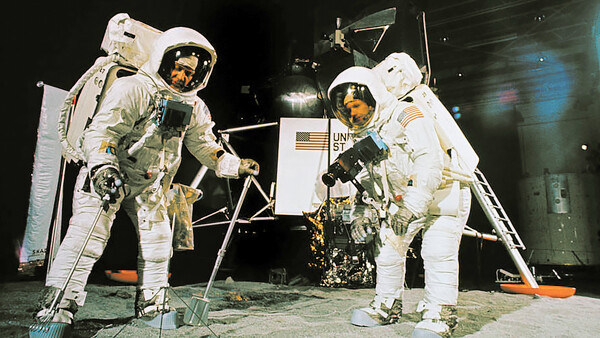
Aldrin and Armstrong practice collecting moon rocks in a studio at NASA in Florida prior to the moon launch.
NASA
A TV camera filmed Armstrong walking on the moon.
No one filmed him walking. There was a camera mounted to record him.
NASA contracted with Westinghouse to develop a small black and white camera for $2.29 million that could condense the capabilities of a large television studio camera into a lightweight camera, according to the National Air and Space Museum.
"The camera was stored for flight in the lunar module's Modular Equipment Stowage Assembly (MESA), a compartment near the ladder that Armstrong climbed down to reach the Moon's surface. To activate the camera, he pulled on a handle that in turn released the door to the MESA," the site reads.
Additionally, the camera and film were specialized to withstand space elements. The film didn't melt because it wasn't average cellulose film, Brown said.
Astronaut John Young did have a shadow.
"Young was leaping above the ground," Brown said, explaining the supposed lack of a shadow in the iconic photo from the Apollo 16 landing. "That's an optical illusion, he's not standing on the mound. He's about two feet above the ground. He was giving a little navy salute to the flag and then he did it again."
Young's shadow is actually lower and to the right of him.
Brown also pointed out that the Soviet Union and the U.S. shared findings with each other to corroborate facts.
If the landing was fake, the Soviets could have called it out, creating massive outrage, but they didn't because it wasn't, Brown said.
"In all that time (since 1969), not a single engineer, scientist, actor or contractor who was directly involved have come forward (saying it was fake)," he said. "How hard would it be to keep a secret that big for so long? Pretty hard, I would say. I would think it would be impossible."