
The Daily Standard
Story Archive


Using food scraps, spices and produce as dyes is a fun recipe for colorful Easter eggs.
CELINA - With Easter just a hop, skip and a jump away, Peter Cottontail teamed up with The Daily Standard to dye eggs the natural way with food scraps.
Spending an afternoon working on a spring craft can serve as the perfect respite from the busy tasks the holiday may demand, including baking treats, preparing Easter dinner, visiting with family or attending faith services, assembling children's baskets and hunting for eggs.
Dyeing eggs from scratch may sound overwhelming, but anyone can do it at home - including any kiddos bored on spring break - while also learning about a centuries-old tradition. Decorating eggs is believed to predate Christianity, according to Folklife Today, a blog from the Library of Congress.
Colored eggs appear on altars made for the new year, a tradition with ancient roots in Persia and Zoroastrianism. Historically, red was a popular color. Orthodox Christians in Mesopotamia took the symbol of the Passover egg and dyed it red as a symbol of Christ's blood, the blog post reads.
Fabric dyes were used to color the eggs, and were later replaced by food-safe dyes. The earliest dyes came from nature, according to the Michigan State University Extension. Yellow onion skins and turmeric make yellow; berries can produce blues, reds, pinks and purples; red cabbage leaves turn purple, beets make pink or purple shades; and spinach makes for a light green color.
Using natural dyes is an art, not a formula to follow, but using color theory can allow the artist to create complementary colors.
The Daily Standard recently dabbled in the creative space and made its very own naturally dyed eggs using frozen berries and various spices.
The blueberries made for a blue-gray color, pomegranate seeds dyed the eggs a light pink, heaping spoonfuls of turmeric turned the eggs a deep yellow-orange color and paprika made for an orange egg. Using color theory, the newspaper staff combined the dye liquids of turmeric and blueberries to make for a mustard yellow-green color.
Like any other food, handling fresh eggs can pose a health risk as fresh eggs can contain salmonella, a foodborne illness that is the common cause of food poisoning.
When buying fresh eggs, store them immediately in a clean refrigerator at a temperature of 40 degrees or below. Use them within three weeks, according to a fact sheet from the Food and Drug Administration. Additionally, use or eat hard-boiled eggs - in the shell or peeled - within one week after cooking. Refrigerate leftover cooked egg dishes and use within three to four days.
The United States Department of Agriculture reminded those celebrating the holiday to practice food safety guidelines.
Bacteria multiply rapidly between 40-140 degrees, a temperature range called the "danger zone." Food should be left in that zone for no more than two hours. Perishable foods, such as ham slices, brisket and deviled eggs, should be discarded if left out for longer than two hours in the "danger zone," according to USDA.
USDA also recommends making two sets of decorated eggs - one for hiding and one for eating. For egg hunts, use plastic eggs.
This simple recipe from the MSU Extension is easy to follow.
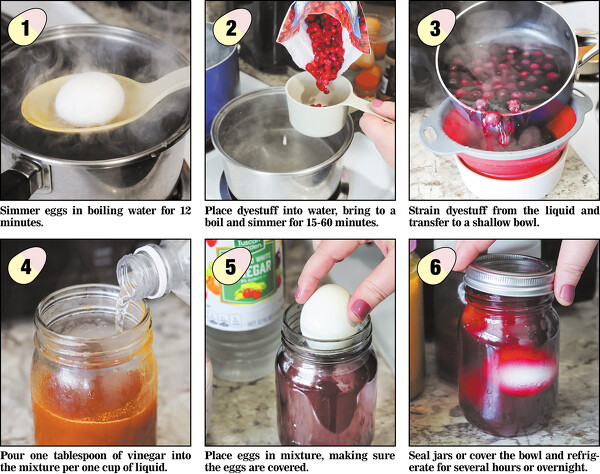
Dye Easter eggs the natural way:
1. Boil eggs by simmering in boiling water for 12 minutes.
2. Place dyestuff into water, bring to a boil and simmer for 15-60 minutes.
3. Strain dyestuff from the liquid and transfer to a shallow bowl.
4. Pour one tablespoon of vinegar into the mixture per one cup of liquid.
5. Place eggs in mixture, making sure the eggs are covered.
6. Seal jars or cover the bowl and refrigerate for several hours or overnight.
Ingredients:
Food scraps, spices or produce
Water
Hard-boiled eggs
Vinegar
Various bowls
Saucepans
Directions:
Start with hard-boiled eggs. The craft also works with emptied out eggs, which you can make by piercing a small hole into both ends of the raw eggs and then blowing out the egg white and yolk. Wash and dry the egg, but be mindful that empty eggs are more fragile and have to be weighed down to be dyed.
Gather the dye material. This is where crafters can use their artistic freedom. MSU Extension provided recommendations for color swatches. Fresh beets, cranberries, radishes or frozen raspberries make pinkish red; yellow onion skins, orange; orange or lemon peels, carrot tops, celery seed or ground cumin, delicate yellow; ground turmeric, dark yellow-gold; spinach leaves, pale yellow; Yellow Delicious apple peels, green-gold; canned blueberries or red cabbage leaves, blue; strong brewed coffee, beige to brown; dill seeds, brown-gold; chili powder, brown-orange; purple or red grape juice or beet juice, grey.
Other options can include hibiscus flowers, lavender buds, butterfly pea flowers, pomegranate juice, red onion skins, grass or cherry juice.
Cover the material with water and bring to a boil. Keep in mind that the food scraps will be less potent than food-safe dye. Reduce the heat and simmer about 15 minutes or up to an hour until the desired color, the recipe reads.
Strain out the material and transfer the liquid into a small bowl that holds enough to cover the egg. Add in a tablespoon of white vinegar for each cup of liquid.
Carefully lower the eggs into the mixture and let them sit for several hours or overnight.
Remove the eggs from the liquid and rinse. Once dry, admire the creation or crack it open to make egg salad, deviled eggs or any other protein-dense snack.