
The Daily Standard
Story Archive

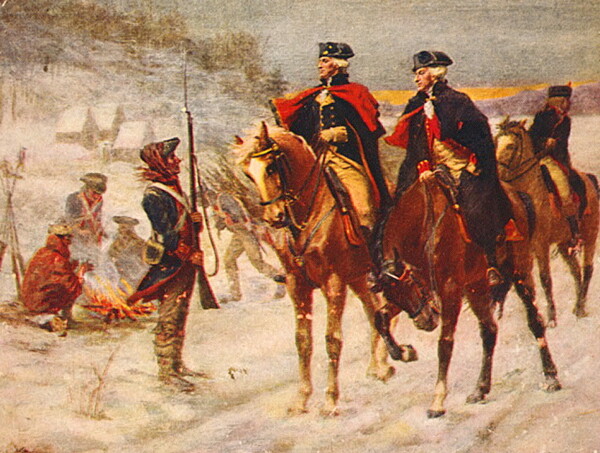
George Washington and Lafayette at Valley Forge. Painting by John Ward Dunsmore, published 1907.
CELINA- The Marquis de La Fayette crossed an ocean to fight for American independence at just 19 years old, earned George Washington's trust and became a hero of the Revolution.
In the June lecture of Mercer County Historical Society's yearlong, monthly series on George Washington's generals in accordance with the country's 250th anniversary, Riley House Museum Director Cait Clark explored Lafayette's heroic life.
Marie-Joseph Paul Yves Roch Gilbert du Motier de La Fayette, known as the Marquis de La Fayette, or more commonly- as Lafayette in the United States- was a French nobleman and military officer born on Sept. 6, 1757 to a well connected couple in the Auvergne region of the Kingdom of France.
"Lafayette was lucky in the sense that both the elder brothers of his parents both died young, and so those inheritances filtered down to Lafayette's parents, and then of course to him. So, he almost was not much of a noble at all. ... His father's name was Michel Louis Christophe Roch Gilbert du Motier, Marquis de La Fayette, and his mother's name was Marie Louise Jolie de La Rivière," Clark said. "These names showed their connections in the French court, that unfortunately, by this time, were not very profound. In fact, his mother was better connected than his father was, which we will see how that helps him very shortly."
Lafayette's father was killed by a cannonball while fighting in Germany in the Seven Years War when Lafayette was just a toddler, making him the Marquis de La Fayette at just 2 years old.
A Marquis is a nobleman of hereditary rank in Europe, below a duke but above an earl and a baron.
"After that, his mother returned to Paris, France. He was raised by his grandmother for about five years. He barely saw his mother at all. Why did she leave? Well, she understood that in order for the young Marquis de La Fayette to become anyone, he would have to have connections to Paris and by association the royal family," Clark said. "She left for Paris, France and worked for five years in creating connections for her young son. It was during this time that Lafayette got a lot of his very, very early education. He was (in) what was called nobility of the sword, which means that his family got all of their prestige and wealth from military endeavors."
When Lafayette was around 10 years old, his mother returned and brought him with her to Paris, Clark said.
"It was a place of enlightenment and learning," she said. "And that's where young Lafayette would step into the role that his mom had been preparing him for the last seven years at that point. He was unfortunately only there for about two years before he would become an orphan. His mom would pass away when he was only 12 years old.
Because of that, he inherited all of those riches directly to himself from her control. His estates actually brought in about 78,000 livres annually, which for that time, a 12-year-old getting that kind of money from his foreign estates was unheard of, especially someone who had started off in a rather remote chateau that had no court connections. He was one of the wealthiest people in France- even when compared to the actual Royals- overnight at the age of 12 years old after his mother died."
As a result of his notable wealth and title, Lafayette married Marie Adrienne Françoise de Noailles, 14, on April 11, 1774, when he was 16, after a two-year, arranged engagement.
His wife belonged to the Noailles family, one of the most powerful and wealthy houses in 18th-century France.
"They were very, very well connected in the French court, just to give you an idea of how well connected- her father was the King's direct advisor, and her mother was Maria Antoinette's social etiquette coach. So Adrienne's social status was beyond being beat," Clark said.
Not long after he was married, Lafayette began to take an interest in what was going on across the sea. He'd learned from a man called Comte de Broglie that the British colonies in America were starting to stand up against the French and the British monarchy.
Broglie invited Lafayette to dinner with Prince William Henry, Duke of Gloucester and Edinburgh.
"It just so happens that this Prince William Henry is the younger brother of King George III of Great Britain, the same King George III who is waging war against the American colonies," Clark said. "The interesting part is that Prince William Henry is the black sheep of the British royal family, and he does not support his brother. Actually, Prince William Henry supports the American cause. Prince William Henry and Lafayette sit down to dinner, and Prince William Henry starts talking about these ideals of freedom of liberty, how he supports the American colonists against his own brother. And it's said that by the end of this dinner, Lafayette has gotten into his mind that not only does he support the American colonies, but he himself is going to go to America and he's going to fight against Britain."
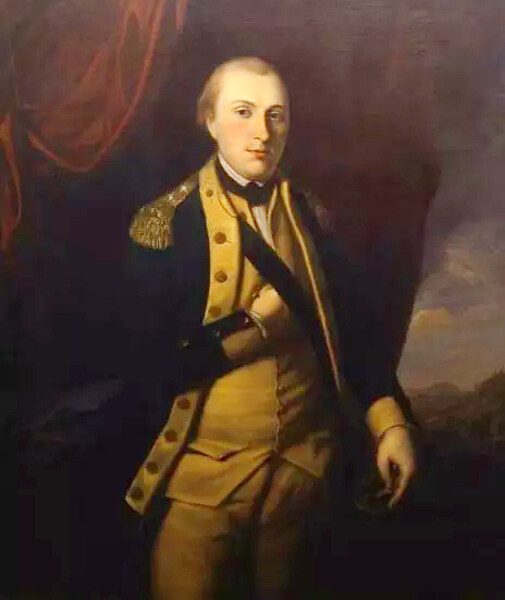
Lafayette made his final visit to the United States in 1824 as the last surviving general of the American Revolution to tour the country.
Not long after, at age 19, Lafayette decides- without asking permission from the French King- he is going to buy a ship called La Victoire, and secretly sail to America and get involved in the Revolutionary War.
"Well, en route to the ship, he writes a letter to his father-in-law, and he said, of America, 'Their interest will always be more dear to me than my own.' He has never, to our knowledge, met an American in his life, and yet he is deeply, already interested in this war," Clark said. "His father-in-law, like any good father-in-law, he immediately reaches out to the king and demands that the king arrest his son-in-law hopefully before he gets to set sail. And so, King Louis XVI gets involved, and Lafayette agrees, 'OK, I will come back and we will be done with this. We will take a tour of Italy as a family, and it'll be fine.'"
That never happens though, and Lafayette ends up evading King Louis, and headed to America on the ship that he bought with his own money. Along the way he gathered about 12 other nobles that were also interested in going to America for their own fortunes and prestige.
After he arrived in America, he and the other French nobles were initially met with suspicion and turned away until Massachusetts delegate James Lovell vouched for them, with Lafayette ultimately earning support because he sought only to serve the American cause rather than receive pay.
"He accepts the appointment of Major General immediately with no pay. A few days later at the City Tavern, … Lafayette is there, and they're celebrating his new commission, and across the room for the very first time, he sees George Washington and Lafayette notes their physical similarities immediately," Clark said. "Washington is about 6 foot 4 inches, very tall for that time period. Lafayette is also unusually tall and broad shouldered for his time period. And Lafayette, according to his writings, he always felt a bit like a bull in a china shop among the French aristocracy. He had always been larger than life- both in spirit and in body. But, he noticed that Washington wasn't bothered by his stature, and he looked up to him because of that. They also had similar bright red hair that they kept neatly powdered, the same gray blue eyes, and they noticed these things about each other."
The two would go on to become close friends, with Lafayette and Adrienne naming one of their four children- Georges Washington de La Fayette- after him.
Though that was not the case at first, Clark noted, as Washington looked at Lafayette's title as only an honorary position; he had no intention of actually giving him a role as a major general.
"But then comes the Battle of Brandywine. Lafayette doesn't have any kind of command yet, of course, because despite being nobility of the sword, Washington knows that he has no real military experience to speak of. Lafayette has never seen real combat," she said. "He's well trained in military procedure, but he's never seen it. So Washington attaches him to (Major General John Sullivan's) group at the beginning of this battle. To summarize the battle quickly, British General William Howe starts to fold Washington's flank inward and Sullivan's men start a chaotic retreat. They're going to be collapsed in on, and it's shaping up to be a complete disaster."
Lafayette tried to rally Sullivan's group, and while organizing a retreat, he was shot in the leg, Clark said. Despite his wound, he continued directing troops until he nearly fainted from blood loss.
Washington rushed to his side after learning Lafayette might die, and the young French noble's courage and humor during his recovery strengthened their friendship and helped cement his reputation as a devoted patriot willing to sacrifice for the American cause, she said.
"After that, Lafayette and Washington became quite a bit closer. This is when the public finally starts to realize that this French nobleman is one of them. He's a patriot. He's an American. He's willing to believe, potentially even die, for the cause," Clark said. "Even though Brandywine was an American catastrophe, this is really when Lafayette star starts to rise."
Outside of his role in the American Revolution, Lafayette was also around for the French Revolution that began in 1789.
As commander of the National Guard of Paris, he tried to keep order and steer a middle course, supporting constitutional reforms and individual rights while opposing both the monarchy's abuses and the growing violence of radical revolutionaries, Clark said. His efforts ultimately satisfied neither side. After the National Guard fired on protesters during the Champ de Mars Massacre, his popularity collapsed. Branded an enemy of France, Lafayette fled toward the Netherlands but was captured by Austrian forces and spent over five years in prison.
After the death of his wife in 1807, Lafayette made his final visit to the United States in 1824 as the last surviving general of the American Revolution to tour the country.
"By this time, Lafayette, who had largely funded two revolutions from his own pocket, is poor and in bad health. Lafayette is poor at this point. And so, America's gift to him is several acres of land and a gift of $200,000 that'll keep him comfortable the rest of his life," Clark said. "In Richmond, Virginia, while riding a carriage, he stops at the Bunker Hill Monument where he laid the cornerstone on the 50th anniversary of the battle. It was the first major battle the American Revolution."
Lafayette died a decade later on May 20, 1834 after catching pneumonia while out in a thunderstorm. He was buried in the Picpus Cemetery in Paris. The cemetery was founded by his wife, Adrienne during the French Revolution. It remains the only private cemetery in France for direct descendants of victims of the Reign of Terror.