The Daily Standard
Story Archive

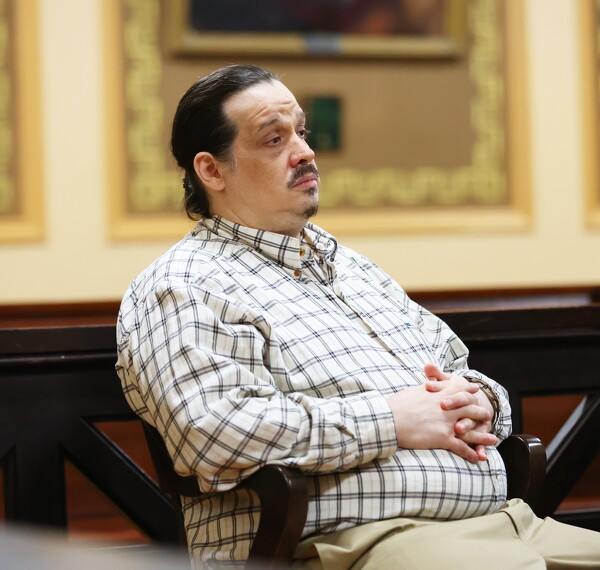
In July 2025 Johnathon H.L. Grove was found guilty of first-degree felony rape and several other felony sex crimes. He was sentenced to more than 100 years in prison in August.
CELINA - Following allegations of juror misconduct, a visiting judge is weighing whether or not to allow a new trial for a 45-year-old Columbus man convicted and sentenced in Mercer County Common Pleas Court to more than 100 years in prison for first-degree felony rape and a host of other child sex crimes.
Johnathon H.L. Grove was sentenced in August to between 104 ½ years and 108 years in prison on 29 counts of illegal use of a minor or impaired person in nudity-oriented material or performance, a second-degree felony; one count of importuning, a third-degree felony; one count of importuning, a fifth-degree felony; four counts of unlawful sexual conduct with a minor, a third-degree felony; one count of rape, a first-degree felony; four counts of disseminating matter harmful to juveniles, a fourth-degree felony; and one count of disseminating matter harmful to juveniles, a fifth-degree felony.
If released he is also required to register as a tier III sex offender every 90 days for life.
Grove was convicted of the crimes by a Mercer County jury in July 2025 after a week-long trial.
He made it clear prior to the end of his sentencing hearing that he planned to appeal the verdict, as anyone convicted in Ohio after a trial has the right to appeal the final judgment within 30 days of its issuance.
Grove subsequently filed a notice in September indicating he would appeal the final verdict. However, before that could be sorted out, his trial counsel - Lima attorneys Andrea Henning and Cheyenne Winegardner - requested in November that they be allowed to submit a motion for a new trial due to juror misconduct.
They were required to ask whether or not they could motion for a new trial due to the filing's timing.
"The motion for a new trial could not have been filed within the limits prescribed in (state law) because (the) defendant wasn't aware of the misconduct until after the limit has expired," their motion states.
After submitting an affidavit that laid out the allegations of juror misconduct involving a former law clerk of Mercer County Common Pleas Judge Matthew K. Fox, Fox promptly recused himself from the matter due to a possible conflict of interest.
Visiting Judge Jonathan P. Hein of Darke County was then assigned to the case.
Within their request for a new trial, Henning and Winegardner alleged that former Mercer County law clerk Trevor Kriegel communicated with juror Gregory Axe before and during the trial "and that those communications were prejudicial to Mr. Grove receiving a fair trial," a court affidavit states.
Henning wrote in an affidavit that in September of 2025, Kriegel approached her at the Auglaize County Municipal Court with questions about her trial strategy during the Grove case.
"I am familiar with Kriegel because he had been introduced to me as a former law clerk of Judge Fox and had been an observer during most of the trial which took place July 14-17, 2025," Henning wrote in an affidavit. "It is my understanding that Kriegel had clerked for Judge Fox at times in which the defendant's case was pending on Judge Fox's docket and that he was familiar with the facts of the case."
During their September conversation, Henning said Kriegel told her he knew Axe personally and that Axe contacted him after he was selected for the case, then again while the trial was ongoing.
"Kriegel stated that during the first contact, Axe had wanted to talk about the case, but that Kriegel told Axe they could not speak about the case," she wrote.
Per state law, jurors are not permitted to discuss the case among themselves or with anyone else until all of the evidence is presented, attorneys have made their closing arguments and the judge has instructed them of the rules that apply to the case. As well, they are not allowed to discuss the case with anyone outside of the courtroom until after they have deliberated and arrived at a verdict.
"At that time, I questioned Kriegel as to whether he and Axe had discussed the case during the second conversation that took place while the trial was still ongoing," Henning wrote. "I was concerned that Axe and Kriegel had discussed the facts of the case during the trial because a second conversation had taken place between the two despite Kriegel's purported admonish to Axe that they could not talk about the case."
He then assured her that they never discussed the facts of the case, she wrote. After further reflection and a discussion with her co-counsel, Winegardner, Henning said they decided to ask Kriegel some follow-up questions about his contact with Axe. She then obtained Kriegel's phone number through a mutual acquaintance and reached out to him.
Once contacted, Kriegel "readily agreed to meet," per Henning. During their meeting, he informed both attorneys that he and Axe went to school together and were childhood friends. He then reportedly said that Axe contacted him on or about June 20-21 when he got notice that he was in the jury pool for the upcoming session. Then, Kriegel told them that Axe reportedly reached out again on the first day of the trial once Axe was seated on Grove's jury.
"Kriegel indicated that during the July 14th (the first day of the trial) conversation, he told Axe 'I know this case pretty well.' Kriegel indicated that he can't confidently say whether or not they discussed the charges," Henning wrote. "Kriegel also indicated that he asked Axe to uphold Grove's rights and follow the law."
In addition, he reportedly told Grove's counsel that during one day of the trial, he didn't recall exactly which day, that he and Axe saw each other outside of the courthouse and walked around together during the trial lunch break, Henning's affidavit states.
"During (the meeting with Henning and Winegardner) Kriegel picked up his phone and was interacting with it. I initially believed that he was looking at his text and phone log to determine the dates that conversations with Axe had taken place. Kriegel took what seemed to be an inordinately long time to locate messages on the phone and was interacting with the phone in a way that caused me to become concerned that he was deleting text messages," she wrote. "After Kriegel had been interacting with his phone for a prolonged period of time, I asked to see it and he agreed."
While looking at the phone, Henning noted a June 20 missed call from Axe to Kriegel; a three-minute call between the two on June 21; a 10-minute call at 3 p.m. July 14; a missed call and texts between the two regarding lunch on July 15; and a call from Kriegel to Axe on July 17.
As well, they observed a text from Kriegel to Axe "sent immediately after the verdict was announced," that stated "MY BOY!" Winegardner wrote in her own affidavit.
"When asked about the meaning, Mr. Kriegel laughed nervously and gave no clear explanation," she added. "Mr. Kriegel was visibly nervous throughout - red in the face, shaky and defensive - and repeatedly insisted that he and Mr. Axe had not discussed the facts of the case."
He reportedly then refused to give them Axe's phone number initially, citing Axe's privacy, Winegardner wrote in court filings. He later agreed to provide Axe's number.
The attorneys immediately contacted Axe via phone call following their second meeting with Kriegel, she noted.
"Mr. Axe was evasive and refused to discuss the matter, stating only that 'we didn't talk about anything' and that such discussion 'would be illegal.' He repeatedly indicated he wanted nothing to do with the matter and declined our request to meet in person, insisting that there was nothing to talk about," Winegardner's affidavit states.
Assistant county prosecutor Peter Galyardt opposed the defense's request to file a motion for a new trial on Dec. 19, citing a lack of evidence that they did not know about the purported juror misconduct within the time provided.
" … Even if his motion for leave is deemed a proper path, Grove failed - in his leave request - to establish 'by clear and convincing proof that [he] was unavoidably prevented from filing' a motion for a new trial 'within the time provided' by rule," Galyardt wrote.
In a judgment filed on Jan. 12, Hein deemed Henning and Winegardner's affidavits to be timely filed.
He is now considering the defendant's motion for a new trial.
Grove's case stems from a sexual encounter and months-long sexually explicit correspondence he had with the then 12-year-old female victim, who resided in Fort Recovery.
He met the preteen in late 2020 through his daughter, also 12 at the time, and quickly began a correspondence with her via Facebook direct messages and video chats.
The messages quickly became sexually inappropriate, with Grove encouraging the minor to look up various pornography websites, sending her images with text alluding to the act of rape and soliciting sex from her multiple times.
The video chats, sometimes lasting as long as two hours, also commonly involved nudity and masturbation at Grove's request. Unbeknownst to her at the time, Grove took 32 sexually explicit screenshots of their video calls and saved them on two hard drives.
The girl's father found their messages a couple of months later in 2020, and the relationship slowed because he began monitoring her online activity more closely.
However, the messages and calls between the two continued, and on Dec. 1, 2022, the pair eventually met in person at the girl's home in Fort Recovery. The meeting involved multiple sexual encounters between the two. During one of the encounters, the girl testified that she, then 14 years old, told Grove to stop several times and physically tried to push him away, but he did not stop.
The two continued to communicate briefly following the meeting, again sharing sexually explicit messages and video chats that involved nudity and masturbation, on a phone Grove gave the girl and told her to keep hidden.
Prosecutors maintained throughout his trial that due to circumstances out of the child's control, including a father that suffered from addiction and an estranged mother that eventually died by suicide, she was left vulnerable and starved of attention. Galyardt said Grove knew this, and took advantage of it for "his own sexual desires."
Grove is currently incarcerated at the Allen-Oakwood Correctional Institution in Lima.